Emotional Freedom Techniques (EFT for short) are an accessible tool for processing and releasing negative emotions and limiting beliefs that may be the root cause of our emotional, behavioral, and physical challenges. EFT is a gentle blend of exposure, cognitive, and somatic therapy that “speaks the language” of our nervous system to transform how we feel.
While EFT is still being researched and is not yet among the official methods in traditional psychotherapy, it shows a powerful and lasting therapeutic effect — often working faster than talking therapies. Due to the undeniable evidence of its benefits, EFT has been recognized and integrated into many health-care facilities and schools worldwide.
Working with these techniques helps lower stress levels and accumulated anger, resentment, fear, shame, guilt, grief, etc. This leads to a calmer mind, inner peace, and a fresh perspective on ourselves, others, and life in general. As a result of the mind-body connection, physical symptoms often improve or disappear entirely.
Origins and Development of the Method
Although it has gained global popularity in recent decades, EFT is rooted in ancient Eastern medicine and the knowledge of the body’s energy meridians.
The Beginning: In the 1980s, American psychologist Dr. Roger Callahan discovered that tapping on specific acupressure points could drastically reduce the intensity of phobias and emotional pain. His breakthrough came while working with a patient who had a severe fear of water — by tapping under the eye (a point on the stomach meridian), her fear vanished in minutes.
Simplification: In the 1990s, his student Gary Craig (a Stanford-trained engineer) refined and simplified the system. He created a universal protocol that is easy for anyone to learn and apply. This gave birth to EFT (Emotional Freedom Techniques) — the method that today helps millions of people worldwide regulate their nervous systems on their own.
Today: EFT is one of the most researched methods in energy psychology, recognized globally for its speed and effectiveness.
Two Forms of EFT
The Science Behind EFT: How Tapping Calms the Nervous System
Many people wonder how something as simple as tapping can have such a profound effect. Science provides the answer:
The Amygdala and the Safety Signal
The amygdala is the brain’s center that triggers the autonomic nervous system’s “fight or flight” response. When we are under stress, it sounds the alarm. Studies (including those from Harvard) show that EFT tapping sends a direct calming signal to the amygdala, quickly switching the body from survival mode to a state of rest.
Interrupting the Stress Response
EFT acts as a bridge between the mind and the body. While the conscious mind is focused on the problem, tapping on the acupuncture points signals the nervous system to deactivate the tension.
Biochemical Changes in the Body
Scientific research on the EFT method shows that beyond changes in mood and emotions, biochemical processes in the body also change:
Improved immune system function;
Reduction in cortisol (the stress hormone) levels by 24% to 43%, according to various studies;
Regulation of blood pressure;
Changes in the expression of 73 genes (after just 1 hour of tapping);
Reduction in uncontrollable food cravings as a physiological impulse;
And more.
In the series The Science Behind Tapping, three short videos present scientific research on EFT tapping.
EFT Tapping Points: Where and How?
Basic EFT Points
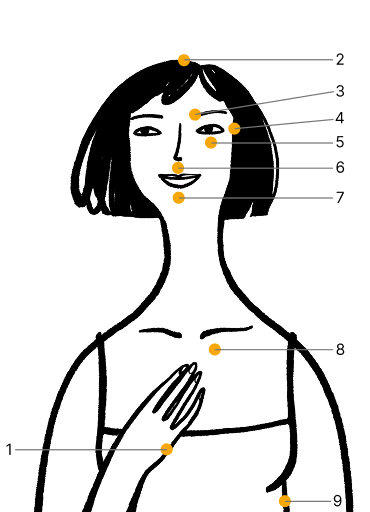
In Gold Standard EFT, we use 9 primary points. These correspond to the beginning or end of the major energy meridians in the human body. You don’t need to be precise down to the millimeter — simply tapping in the area is enough to send a signal to the nervous system.
Side of the Hand - Also known as the “Karate Chop point.” This is where we start with the Setup Phrase.
Top of the Head - At the center of the crown — several meridians intersect here.
Eyebrow - Exactly where the eyebrow hairs begin.
Side of the Eye - On the bone at the outer corner of the eye.
Under the Eye - On the bone directly under the eye.
Under the Nose - In the indentation between the nose and the upper lip.
Chin Point - In the indentation between the lower lip and the point of the chin.
Collarbone - Just below where the collarbone and the first rib meet.
Under the Arm - On the side of the body, about 10 cm (4 inches) below the armpit.
There are 5 additional points on the fingers (at the base of each nail), but their use is typically not required.
How to Do EFT: The Basic Recipe
Emotional Freedom Techniques go beyond the Basic Recipe, but it perfectly illustrates the process. Here are the steps:
Identify the Problem: Choose a specific emotion, memory, or physical sensation you want to work on (e.g., “Anxiety and tension in my chest”).
Assess the Intensity: Determine how strong the feeling is in the moment on a scale of 0 to 10, where 10 is maximum discomfort.
The Setup Phrase: While tapping the Karate Chop point, repeat a phrase that acknowledges the problem and accepts yourself.
Example: “Even though I feel this anxiety and tension in my chest, I deeply and completely accept myself and how I feel.”
The Tapping Round: Tap sequentially on the EFT points from the top of the head to under the arm (see illustration), repeating a reminder phrase at each point (e.g., “This anxiety”) to keep your mind focused on the issue.
Re-evaluate: After one or two rounds, check the intensity on the 0-10 scale. Usually, the number decreases. Repeat steps 3 to 5 until the tension is completely gone.
If you wish to deepen your study of EFT independently, the complete manual is distributed for free on Gary Craig’s website - Gold Standard EFT Tapping Tutorial.
Optimal EFT – The Evolution (Without Tapping)
As a method, EFT never stops evolving. Its creator, Gary Craig, introduced the concept of Optimal EFT or “The Unseen Therapist” in 2014. This is the next level of emotional freedom, working without physical tapping through focused awareness and a connection to our inner source of peace.
Optimal EFT is an even more powerful, rapid, and comprehensive method. It can be used instead of Tapping for emotional work or as a spiritual path for growth and connection with our Higher Self.
I will discuss Optimal EFT in more detail in a separate article.
If you are interested, you can read the free e-book on Optimal EFT at Gary Craig’s site - The Unseen Therapist e-book.
How Can EFT Help?
EFT is a universal tool because it works directly with the nervous system. Since almost every problem (physical or emotional) has a stress component, the spectrum of application is incredibly broad.
There are no known contraindications. It can be used alone or in combination with other practices, therapies, or medical treatments.
Common areas where EFT achieves results:
Emotional Release: Dealing with anxiety, anger, guilt, shame, or unpleasant memories.
Stress and Burnout: Reducing daily tension and chronic fatigue.
Depression: Gently moving out of states of hopelessness and lack of motivation by releasing accumulated emotional weight.
Traumatic and Painful Experiences: Safely processing emotional trauma or past events that continue to weigh on the present.
PTSD: One of the most researched applications of EFT, helping to calm the body and mind after severe shock.
Fears, Phobias, and Panic: Fear of flying, public speaking, panic attacks, social anxiety, and more.
Limiting Beliefs and Low Self-Esteem: Overcoming thoughts like “I’m not good enough” or “I’m afraid of failure.” EFT shifts self-sabotage into healthy self-worth based on inner security.
Relationship Issues: Clearing emotional triggers that hinder healthy communication.
Sleep Problems: Calming the nervous system at night to end racing thoughts and insomnia.
Eating Disorders and Emotional Eating: Addressing emotional hunger and breaking impulsive food habits.
Addictions and Habits: Reducing cravings and the emotional needs behind addictions.
Achieving Goals: Clearing the inner resistance that prevents us from taking action.
Physical Symptoms: Improvement or complete resolution of symptoms and conditions that have an emotional root. The body’s natural self-healing abilities activate when resources are no longer consumed by survival.
Note: While EFT is a powerful tool for emotional and physical well-being, it is currently in the process of research and is not yet considered an official method in traditional psychotherapy; therefore, this information is for educational purposes. Consult with a qualified physician or mental health professional regarding any medical or psychological conditions.
We Cannot Be in Survival and Growth Simultaneously
It is our responsibility to care for ourselves by releasing stored emotions like anger, resentment, guilt, fear, shame, and grief that keep us hostage to survival. For the nervous system, “survival” is not a metaphor. Any circumstance perceived as threatening triggers a physiological mode to cope with the threat. In that state, the primary goal is not to develop, grow, or flourish, but simply to stay alive.
I encourage you to move toward growth, whether you choose EFT or another modality. Our flourishing benefits not only ourselves but everyone around us.